
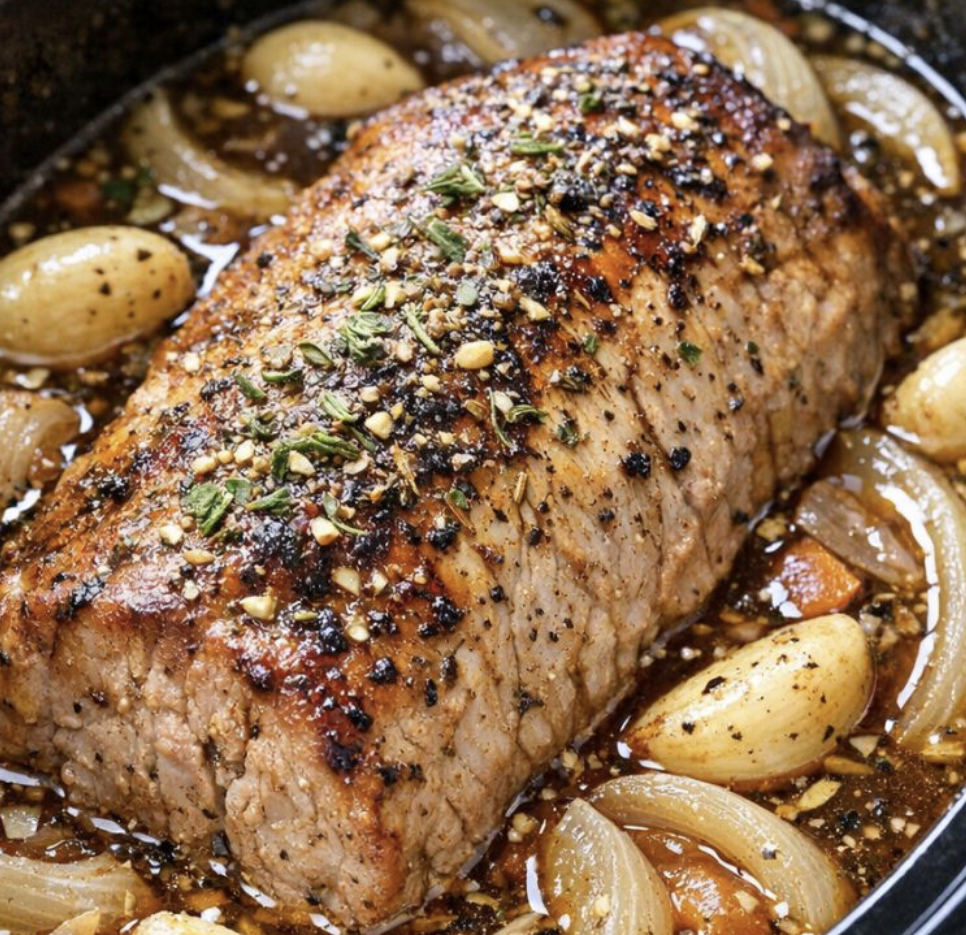
Servings: 6
Slow Cooker Size: 5 to 7 quarts
Cook Time: 7–8 hours on LOW or 4–5 hours on HIGH
Active Time: 5 minutes
Ingredients
-
1 (2½ to 3 pound) raw pork sirloin roast, trimmed only if very thick fat cap
-
1 tablespoon kosher salt (or 2 teaspoons fine sea salt)
-
1 teaspoon freshly ground black pepper
-
2 teaspoons garlic powder
-
1 tablespoon dried Italian seasoning (or mixed dried herbs such as oregano and basil)
-
1 cup low-sodium chicken broth
For Serving
-
The herbed garlic jus from the slow cooker
-
Optional: fresh parsley, chopped (for garnish)
A note on the pork sirloin: Pork sirloin comes from the hip area of the pig, near the rear leg. It’s sometimes labeled “pork sirloin roast,” “pork sirloin tip roast,” or simply “fresh pork roast.” It’s a lean cut with a mild flavor – perfect for slow cooking. If you can’t find pork sirloin, pork shoulder (Boston butt) works beautifully, though it’s fattier and will shred more easily.
A note on the salt: Kosher salt is less salty by volume than table salt or fine sea salt. If you’re using fine sea salt, reduce the amount to 2 teaspoons. If you’re using table salt, reduce to 1½ teaspoons. Getting the salt right is crucial for flavor.
A note on the Italian seasoning: This blend typically includes oregano, basil, rosemary, thyme, and sometimes marjoram or sage. If you don’t have Italian seasoning, make your own blend with 2 teaspoons dried oregano, 2 teaspoons dried basil, and 1 teaspoon dried thyme.
Step-by-Step Instructions
Step 1: Place the Pork in the Slow Cooker
Place the raw pork sirloin roast in the bottom of your 5- to 7-quart slow cooker.
If there’s a noticeable fat cap on one side, place the roast fat side up. This allows the fat to slowly render and baste the meat as it cooks, keeping it moist and flavorful.
Step 2: Make the Seasoning Blend
In a small bowl, combine:
-
1 tablespoon kosher salt (or 2 teaspoons fine sea salt)
-
1 teaspoon freshly ground black pepper
-
2 teaspoons garlic powder
-
1 tablespoon dried Italian seasoning
Stir with a fork or your fingers to make an even seasoning blend. It should smell incredible – garlicky, herby, savory.
Step 3: Season the Pork
Sprinkle the seasoning mixture evenly over the top and sides of the pork sirloin roast. Don’t just dump it in one spot – cover as much surface area as possible.
Use your hands to gently press the seasoning into the meat so it adheres. This isn’t a deep rub – just a light pressing to make sure the spices don’t fall off.
Don’t season the bottom of the roast (the side touching the slow cooker). The juices will carry the flavor around, and you’ll save yourself from an overly salty bottom layer.
Step 4: Add the Broth
Pour the 1 cup of low-sodium chicken broth around the sides of the roast into the bottom of the slow cooker.
Important: Pour carefully so you don’t rinse the seasoning off the top of the meat. You want the broth in the bottom of the crock, not on top of the pork. The broth will create steam and a light jus as the pork cooks – it’s not meant to submerge the meat.
Step 5: Cover and Cook
Cover the slow cooker with the lid.
Choose your timeline:
-
LOW for 7 to 8 hours – The best method. The gentle heat keeps the pork incredibly moist and allows the flavors to penetrate deeply.
-
HIGH for 4 to 5 hours – Works in a pinch, but LOW is better for lean cuts like pork sirloin.
Do not lift the lid during cooking. Every time you open the slow cooker, you lose heat and steam, which adds 15–20 minutes to your cooking time.
The pork is done when it reaches your desired level of tenderness:
| Internal Temperature | Result |
|---|---|
| 145°F (63°C) | Safe to eat, still sliceable, slightly firm |
| 165°F (74°C) | Very tender, easily sliced |
| 190–200°F (88–93°C) | Fall-apart tender, perfect for shredding |
For this recipe, I recommend aiming for 190°F to 200°F. At that temperature, the collagen breaks down completely, and the pork becomes incredibly juicy and shreddable.
Step 6: Rest the Pork
Once cooked, carefully transfer the pork sirloin roast to a cutting board. It will be very tender – use two spatulas or meat claws if needed.
Let the pork rest for 10 minutes. This allows the juices to redistribute throughout the meat. If you cut into it immediately, those juices will run out onto the cutting board instead of staying in the pork.
Step 7: Slice or Shred
After resting, decide how you want to serve the pork:
-
For sliced pork: Use a sharp knife to cut the roast against the grain into ½-inch thick slices. Cutting against the grain (perpendicular to the direction of the muscle fibers) ensures each slice is tender, not stringy.
-
For shredded pork: Use two forks to pull the meat apart into bite-sized chunks. The pork should come apart easily at this point.
Discard any large pieces of fat if you prefer.
Step 8: Make the Jus
While the pork rests, skim excess fat from the surface of the cooking juices in the slow cooker. (A flat spoon or a fat separator works best.)
Taste the juices. They should be savory, garlicky, and herbaceous. Add a pinch more salt or pepper if needed.
The juices are not a thick gravy – they’re a light, flavorful jus (French for “juice”). That’s exactly what you want.
Step 9: Serve
Serve the sliced or shredded pork with spoonfuls of the warm herbed garlic jus ladled over the top.
Garnish with fresh parsley if you’re feeling fancy. Then watch everyone go back for seconds.
What to Serve With Pork Sirloin Feast
This pork is incredibly versatile. Here are some winning combinations:
| Base | Vegetable | Why It Works |
|---|---|---|
| Mashed potatoes | Roasted green beans | Classic comfort meal. The jus soaks into the potatoes. |
| Rice | Steamed broccoli | Simple, balanced, weeknight-friendly. |
| Egg noodles | Sautéed mushrooms | Feels fancy. Tastes fancy. Isn’t fancy. |
| Crusty bread | Roasted carrots | The bread soaks up every drop of that garlicky jus. |
| Over a salad | Roasted bell peppers | Sliced cold leftovers make an incredible salad topper. |
For a complete “feast” experience, serve the pork with:
-
Mashed potatoes or creamy polenta
-
Roasted Brussels sprouts or green beans
-
A crusty baguette for sopping up the jus
-
A glass of something cold (iced tea, beer, or sparkling water with lemon)
Storage and Reheating
Refrigerator: Store leftovers in an airtight container with some of the jus for up to 4 days. The pork will absorb the juices as it sits, becoming even more flavorful.
Freezer: Pork sirloin freezes beautifully. Portion into freezer-safe containers with some jus and freeze for up to 3 months. Thaw overnight in the refrigerator before reheating.
Reheating:
-
Oven (best for sliced pork): Place pork in a baking dish, add a splash of broth or water, cover with foil, and warm at 300°F for 15–20 minutes.
-
Microwave (fastest for shredded pork):60–90 seconds per portion. Add a spoonful of jus first.
-
Skillet: Warm over medium-low heat with a few tablespoons of jus or broth.
Common Questions (FAQ)
Can I use a different cut of pork?
Absolutely. Here’s how different cuts perform:
| Cut | Best Use | Notes |
|---|---|---|
| Pork shoulder (Boston butt) | Shredded | Fattier, even more tender. Cook to 200°F. |
| Pork loin | Sliced | Leaner, can dry out. Cook to 145°F only. |
| Pork tenderloin | Sliced | Very lean. Cook to 145°F, reduce time to 3–4 hours on LOW. |
| Pork sirloin (this recipe) | Sliced or shredded | Perfect balance of lean and tender. |
Can I use bone-in pork?
Yes. Bone-in pork sirloin roasts (sometimes called “pork sirloin chop roast”) work beautifully. The bone adds flavor. Just be aware that bone-in roasts may take slightly longer to cook.
Can I cook this without broth?
You can, but the pork will be drier and won’t have the lovely jus. The broth also prevents the bottom of the roast from burning. I strongly recommend keeping the broth.
Can I use beef broth instead of chicken?
Yes. Beef broth will give you a darker, richer, more savory jus. Vegetable broth works too. Use whatever you have on hand.
My pork is tough. What went wrong?
Almost certainly undercooked. Pork sirloin needs time for the collagen to break down. If the meat is tough or chewy, cook it longer – another 1–2 hours on LOW. Don’t worry about overcooking; pork sirloin is very forgiving.
My pork is dry. What went wrong?
A few possibilities:
-
Overcooked at high temperature. If you cooked on HIGH for too long, lean pork can dry out. Next time, use LOW.
-
Too lean. Some pork sirloin roasts are trimmed very aggressively. Next time, look for a roast with some visible marbling.
-
Not enough liquid. Make sure you added the full cup of broth.
For this batch, the jus will help. Shred the pork and let it sit in the warm jus for 15 minutes before serving – it will absorb moisture.
Can I add vegetables to the slow cooker?
Yes. Add chunked carrots, potatoes, or onions to the bottom of the slow cooker before adding the pork. They’ll cook in the juices and become incredibly flavorful. Add them at the beginning.
Can I thicken the jus into a gravy?
Yes. After skimming the fat, pour the jus into a small saucepan. In a separate bowl, whisk 2 tablespoons of cornstarch with 2 tablespoons of cold water. Bring the jus to a simmer and whisk in the cornstarch slurry. Cook for 2–3 minutes until thickened. Season to taste.
Pro Tips From My Kitchen to Yours
After making this pork sirloin feast more times than I can count, here’s what I’ve learned:
-
Don’t skip resting the meat. Ten minutes feels like forever when you’re hungry. Do it anyway. The difference between pork cut immediately and pork rested for 10 minutes is the difference between dry and juicy.
-
Slice against the grain. Look at the pork and find the direction of the muscle fibers. Slice perpendicular to them. This shortens the fibers and makes each bite tender instead of stringy.
-
Save the jus. Even if you don’t use it all immediately, freeze the leftover jus in an ice cube tray. Those little flavor bombs are perfect for adding to soups, sauces, or reheating leftovers.
-
Make this on Sunday. Cook the pork on Sunday afternoon. Shred it. Store it in the fridge with the jus. Then use it all week: over rice on Monday, in tacos on Tuesday, on a salad on Wednesday, in a sandwich on Thursday. One roast, five dinners.
-
Don’t be afraid of the salt. Pork needs salt. A tablespoon of kosher salt sounds like a lot, but most of it stays on the surface and seasons the jus. If you’re using fine sea salt, reduce the amount. If you’re salt-sensitive, start with half and add more at the end.
-
Use a meat thermometer. Guessing doneness is a recipe for dry pork. A $10 instant-read thermometer takes the guesswork out. Cook to temperature, not to time.
A Note on Seasoning: Less Is More
This recipe uses only five ingredients. And four of them are seasonings.
At first glance, that might seem like a lot of salt and spices. But here’s the secret: pork sirloin is a blank canvas. It has a mild, almost neutral flavor. It needs seasoning to come alive.
The salt enhances the pork’s natural flavor. The black pepper adds a gentle warmth. The garlic powder gives savory depth without the risk of burning fresh garlic. The Italian seasoning brings herbaceous brightness.
Together, they create a crust that’s savory, aromatic, and deeply satisfying.
And because the pork cooks low and slow, those seasonings have hours to penetrate the meat. The result isn’t a pork roast with seasoning on the outside. It’s a pork roast that tastes seasoned all the way through.
That’s the magic of simple, smart cooking.
Final Thoughts
This 5-Ingredient Slow Cooker Pork Sirloin Feast is proof that you don’t need complicated recipes to make something extraordinary.
A good cut of meat. A simple seasoning blend. A little broth. A slow cooker. And time.
That’s it.
And what you get in return is a pork roast so juicy, so flavorful, so incredibly tender that it will become a regular in your dinner rotation.
Serve it over mashed potatoes with a ladleful of that garlicky jus. Shred it into tacos or sandwiches. Slice it thin for salads. However you serve it, one thing is certain: you’ll be making this again.
Because sometimes the simplest meals are the ones we love the most.
Enjoy.