
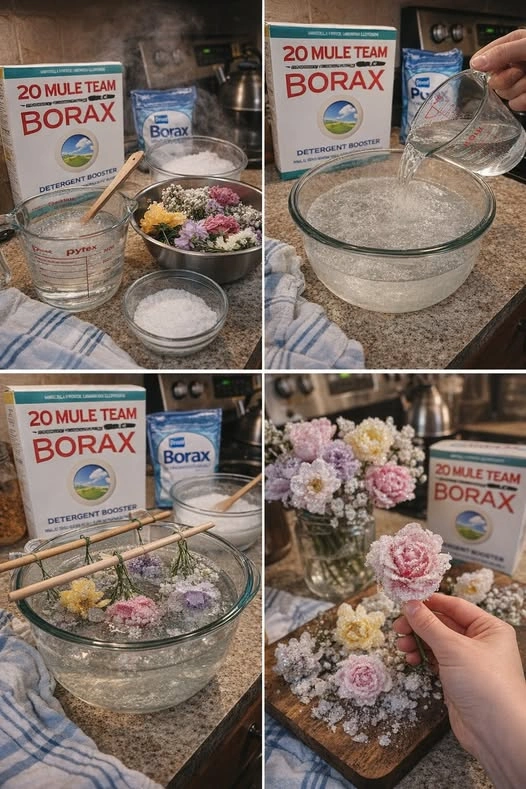
How to Make Easy Crystal Flowers at Home
Making crystal flowers at home is a fascinating science experiment and a beautiful craft project rolled into one. These stunning, shimmering flowers are created using a simple chemical process called crystallization, where dissolved minerals form solid crystal structures as the solution cools or evaporates. The result is a permanent, sparkly decoration that looks like a precious gemstone bouquet. This project requires no special equipment, uses common household ingredients, and produces impressive results within twenty-four hours. Whether you are looking for a rainy day activity with children, a unique handmade gift, or a centerpiece for a special occasion, learning how to make easy crystal flowers at home delivers magical results with minimal effort.
Why This Crystal Flower Method Works
The science behind crystal flowers is called supersaturation. You heat water to dissolve a large amount of a crystalline compound, typically borax or Epsom salt, creating a solution that holds more dissolved material than it would at room temperature. As the solution cools, the water molecules slow down and can no longer keep the dissolved particles suspended. These particles then begin to attach to any rough surface or suspended object, forming organized, repeating crystal structures. Pipe cleaners shaped like flowers provide the perfect framework because their fuzzy, fibrous texture gives the crystals countless tiny anchor points to grab onto. Within six to twenty-four hours, the pipe cleaner flower becomes completely encrusted with sparkling crystals that look like natural gemstones.
Materials Needed for Easy Crystal Flowers
This project uses inexpensive, readily available materials. Most items are already in your kitchen or cleaning closet.
Crystal Growing Materials
-
1 cup of water
-
3 to 4 tablespoons of crystalline compound (choose one option below)
Crystal Compound Options
Option 1: Borax (sodium tetraborate) produces large, chunky, diamond-like crystals. Borax is a laundry booster found in the cleaning aisle. It creates the most dramatic, faceted crystal flowers and is the recommended choice for beginners.
Option 2: Epsom salt (magnesium sulfate) produces smaller, needle-like crystals that resemble frost or snow. Epsom salt is found in the pharmacy or first aid section. It creates a softer, more delicate appearance.
Option 3: Table salt (sodium chloride) produces small, cubic crystals. Salt works but takes longer and produces less dramatic results. It is a good backup option if borax and Epsom salt are unavailable.
Flower Framework Materials
-
Pipe cleaners in any color (chenille stems)
-
Scissors
-
A pencil or wooden skewer
-
String or fishing line
Container and Tools
-
A wide-mouth glass jar or heat-safe container (mason jars work perfectly)
-
A saucepan for boiling water
-
A spoon for stirring
-
Paper towels or newspaper for covering your work surface
Optional Additions
-
Food coloring for tinted crystals
-
Glitter for sparkly crystal flowers
-
Clear acrylic spray sealer for preserving the flowers long-term
Step-by-Step Instructions for Easy Crystal Flowers
Follow these steps carefully for the best crystal formation. Adult supervision is recommended when handling boiling water and borax.
Step 1: Shape the Pipe Cleaner Flower
Select two or three pipe cleaners for each flower. For a simple flower, bend one pipe cleaner into a star shape with five or six petals. Pinch the center tightly to hold the shape. Cut a second pipe cleaner in half. Use one half as the stem by wrapping its end around the center of the flower and twisting to secure. Bend the remaining half into a leaf shape and attach it to the stem. For a more detailed flower, shape individual petals from separate pipe cleaner pieces and twist them together at the center.
Ensure the entire flower fits inside your glass jar without touching the sides or bottom of the jar. The flower must be completely suspended in the solution. If the flower touches the jar, crystals will glue it to the glass.
Step 2: Attach the Suspension String
Tie one end of a piece of string or fishing line to the stem of the pipe cleaner flower. Tie the other end to the middle of a pencil or wooden skewer. The string should be short enough that when the pencil rests across the top of the jar, the flower hangs in the center of the jar without touching the bottom. Test the length by lowering the flower into the empty jar before adding any liquid.
Step 3: Boil the Water
Pour one cup of water into a saucepan. Bring the water to a rolling boil on the stovetop. Using boiling water is essential because hot water can hold more dissolved crystals than cold water. If you are making multiple crystal flowers, scale the recipe accordingly using one cup of water and three to four tablespoons of borax per flower.
Step 4: Dissolve the Crystal Compound
Remove the boiling water from the heat. Carefully pour the hot water into your glass jar. Add the borax, Epsom salt, or table salt one tablespoon at a time, stirring after each addition until fully dissolved. Continue adding and stirring until the solution becomes cloudy and you see a small amount of undissolved powder settling at the bottom of the jar. This indicates the solution is fully saturated. For borax, this typically takes three to four tablespoons per cup of water. For Epsom salt, it takes four to five tablespoons.
Step 5: Add Color and Sparkle (Optional)
If you want colored crystal flowers, add three to five drops of liquid food coloring to the solution and stir. The color will incorporate into the crystals as they form. For a softer pastel look, use fewer drops. For intense jewel tones, use more drops. For glittery crystal flowers, add one teaspoon of fine glitter to the solution and stir.
Step 6: Suspend the Flower in the Solution
Place the pipe cleaner flower into the jar by lowering the string until the flower is fully submerged. Rest the pencil across the top of the jar. Adjust the string length so the flower hangs in the center of the jar, not touching the sides or bottom. The flower should be completely covered by the solution.
Step 7: Wait for Crystals to Form
Place the jar in a location where it will not be disturbed. Do not move, jiggle, or bump the jar while crystals are forming. Crystals need stillness to grow properly. Check the jar periodically. For borax crystals, visible growth begins within two to three hours, and the flower is fully encrusted within twelve to twenty-four hours. For Epsom salt crystals, growth takes slightly longer, approximately twenty-four to forty-eight hours. For table salt, expect two to seven days.
Step 8: Remove and Dry the Crystal Flower
When the flower has reached your desired level of crystal coverage, carefully lift it out of the solution using the string. Do not touch the wet crystals with your fingers, as the oils from your skin can dissolve them. Place the crystal flower on a paper towel or a wire rack to dry. Allow it to dry completely for several hours or overnight. The crystals will become harder and more durable as they dry.
How Different Crystal Compounds Affect the Result
Each crystal compound produces a distinct appearance. Understanding the differences helps you choose the right one for your project.
Borax Crystal Flowers
Borax produces the most impressive crystal flowers. The crystals are large, chunky, and faceted, resembling diamonds or rock candy. They are also the most durable and will last indefinitely when kept dry. Borax crystals grow quickly, often reaching full size within twelve hours. The primary downside is that borax should not be ingested and requires hand washing after handling. Keep borax crystal flowers away from small children who might put them in their mouths.
Epsom Salt Crystal Flowers
Epsom salt produces delicate, needle-like crystals that look like frost, snow, or white fur. The texture is soft and almost fuzzy. Epsom salt crystals are less durable than borax crystals and will crumble if handled roughly. They also have the unusual property of feeling warm when touched due to the way magnesium sulfate reacts with skin moisture. Epsom salt is non-toxic, making it a safer choice for projects with young children.
Table Salt Crystal Flowers
Table salt produces small, cube-shaped crystals that grow slowly over several days. The crystals are hard and durable but lack the dramatic size and sparkle of borax or the delicate beauty of Epsom salt. Salt crystals are safe and edible, though the pipe cleaner flower itself is not. Salt is the best option if you want to demonstrate the crystallization process slowly over a week.
Troubleshooting Common Crystal Flower Problems
If your crystal flowers do not turn out as expected, these solutions address the most common issues.
No Crystals Forming
If no crystals appear after twenty-four hours, the solution was not fully saturated. Remove the flower. Reheat the solution and add more crystal compound until no more will dissolve. Cool the solution slightly, then re-submerge the flower. Alternatively, the location may be too warm. Crystals form best in a cool environment away from direct sunlight, heating vents, or appliances that generate heat.
Crystals Are Small and Powdery
Small, powdery crystals indicate the solution cooled too quickly or the flower was disturbed during growth. Place the jar in a location with stable, cool temperature. Do not check the jar frequently. Each time you move the jar, you disrupt the growing crystals and cause them to form many small, imperfect structures instead of a few large, well-formed ones.
Crystals Only Formed on the Bottom of the Jar
Crystals forming on the bottom of the jar instead of on the flower indicate the flower was touching the bottom or the solution was too saturated. Ensure the flower is fully suspended and not making contact with any part of the jar. If the solution was oversaturated, the crystals may prefer to nucleate on the smooth glass surface rather than the pipe cleaner. Reduce the crystal compound slightly in your next attempt.