
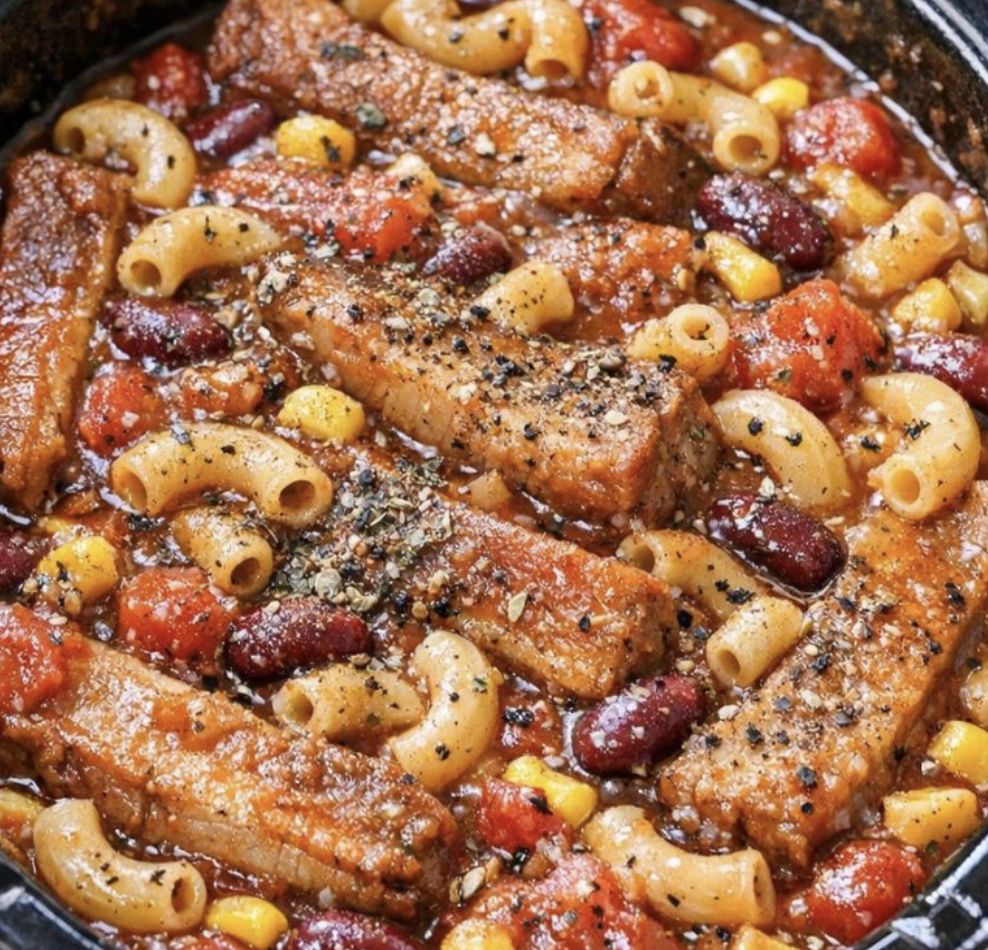
Ingredients (Servings: 4)
-
1 pound raw pork belly strips
-
2 cans (14.5 ounces each) diced tomatoes, with juices
-
4 cups low-sodium chicken broth
-
1½ cups uncooked elbow macaroni (or other small pasta)
-
1 teaspoon salt, plus more to taste
That’s the whole list. No garlic. No onion. No herbs. The pork belly and tomatoes provide all the flavor you need.
Cooking Time at a Glance
| Step | Temperature | Time |
|---|---|---|
| Slow Cooker (first stage) | LOW for 6 hours OR HIGH for 3 hours | 3–6 hours |
| Add pasta and cook | HIGH | 20–30 minutes |
| Total Active Time | – | 10 minutes |
| Total Time (LOW) | – | About 6½ hours |
Step-by-Step Instructions
1. Layer the Pork Belly
Lay the raw pork belly strips in a single layer on the bottom of a 4- to 6-quart slow cooker. They don’t have to be perfect, just spread out so they’re not all stacked in one tight pile.
2. Add the Tomatoes
Open the cans of diced tomatoes and pour them, juices and all, directly over the pork belly strips. This is the heart of the recipe—just dump the tomatoes right over the meat so everything can cook together.
3. Add the Broth and Salt
Pour in the chicken broth around and over the pork belly and tomatoes. Sprinkle the saltover the top. Give the mixture a gentle stir, trying not to disturb the pork belly too much so it stays mostly on the bottom.
4. Cook Until Tender
Cover the slow cooker with the lid and cook on LOW for about 6 hours or on HIGH for about 3 hours, until the pork belly is tender and the broth and tomatoes smell rich and savory.
5. Break Up the Pork Belly
Stir the stew, breaking the pork belly into bite-size pieces with a spoon or fork. Skim off some of the excess fat from the surface with a spoon if you like a lighter broth, or leave it for extra richness.
6. Add the Macaroni
Add the uncooked elbow macaroni to the slow cooker and stir it into the hot tomato and pork mixture, making sure the pasta is mostly submerged in liquid so it cooks evenly.
7. Cook the Pasta
Cover again and cook on HIGH for 20–30 minutes, stirring once halfway through, until the pasta is just tender. If the stew looks too thick for your liking, stir in a bit more hot water or broth to loosen it.
8. Serve
Taste and adjust the seasoning with more salt if needed. Ladle the stew into bowls while hot and serve right away, making sure each bowl gets a good mix of pork belly, tomatoes, pasta, and broth.
The Story Behind “Hoover” Stew
During the Great Depression (1929–1939), millions of Americans struggled to put food on the table. Families got creative with whatever inexpensive ingredients they could find.
“Hoover Stew” (named after President Herbert Hoover, who was in office when the Depression began) was a common Depression-era meal. The original version typically consisted of:
-
Macaroni (cheap and filling)
-
Canned tomatoes (inexpensive and shelf-stable)
-
Hot dogs or cheap sausages (or whatever meat was available)
This version upgrades the meat to pork belly—still very affordable, but far more flavorful than hot dogs. The pork belly renders its fat into the broth, creating a rich, savory stew that would have been a luxury during the Depression but is still incredibly budget-friendly today.
Why Pork Belly?
Pork belly is the cut of meat that comes from the belly of the pig. It’s the same cut used to make bacon (bacon is smoked and sliced pork belly). But unlike bacon, fresh pork belly is unsmoked, un-sliced, and even richer.
Why it’s perfect for this stew:
-
Affordable – Often $3–5 per pound, cheaper than most other cuts.
-
Fatty – The fat renders during cooking, flavoring the entire broth.
-
Tender – Slow cooking transforms the tough connective tissue into silky, melt-in-your-mouth goodness.
-
Flavorful – Pork belly has a deep, savory flavor that stands up to the acidity of the tomatoes.
Where to find it: Most grocery stores carry pork belly in the meat section, often near the pork chops and ribs. If you don’t see it, ask your butcher. Asian grocery stores almost always have it.
Can’t find pork belly? Substitute with:
-
Pork shoulder – Cut into 1-inch cubes. Cook on LOW for 7–8 hours.
-
Beef stew meat – Different flavor, but works. Cook on LOW for 7–8 hours.
-
Smoked sausage or kielbasa – Slice into rounds. Add raw with the tomatoes (no need for the first 6-hour cook time; just add with the pasta and cook 30 minutes).
The Pasta-in-the-Slow-Cooker Trick
Adding uncooked pasta directly to the slow cooker might seem unusual, but it works beautifully.
Why add pasta at the end? If you added the macaroni at the beginning, it would turn into mush after 6 hours. By adding it during the last 20–30 minutes, the pasta cooks perfectly al dente while absorbing the flavorful broth.
Why not cook it separately? Cooking the pasta in the stew itself allows it to absorb the tomato and pork flavors from the inside out. You also save a pot and get a thicker, more stew-like consistency.
Pasta options:
-
Elbow macaroni – Classic choice. Catches the broth in its little curves.
-
Ditalini – Small tubes. Great for soups and stews.
-
Small shells – Catch the broth beautifully.
-
Orzo – Rice-shaped pasta. Cooks in 15–20 minutes.
-
Orecchiette – Little “ears” that hold sauce.
Variations & Tips from My Kitchen
Pork Belly Variations
-
Cut into smaller pieces – If you prefer, cut the pork belly into 1-inch cubes before cooking. They’ll cook faster and be easier to eat.
-
Crisp it first – For added texture, sear the pork belly in a hot skillet for 2–3 minutes per side before adding to the slow cooker.
-
Pork shoulder – More readily available. Cut into 1-inch cubes. Cook on LOW for 7–8 hours.
Tomato Variations
-
Fire-roasted diced tomatoes – Adds smoky depth.
-
Diced tomatoes with green chiles (Rotel) – Adds a little heat and Southwestern flavor.
-
Crushed tomatoes – Creates a thicker, more sauce-like broth.
-
Whole peeled tomatoes – Break them up with a spoon as they cook.
Broth Variations
-
Beef broth – Use instead of chicken for a richer, heartier flavor.
-
Vegetable broth – For a lighter version.
-
Add a splash of red wine – ½ cup added with the broth for deeper flavor.
-
Add a bay leaf – Adds subtle herbal notes. Remove before serving.
Pasta Variations
-
Gluten-free pasta – Works well. Check for doneness early (gluten-free pasta can become mushy quickly).
-
Whole wheat pasta – Adds fiber and a nutty flavor.
-
Add more pasta – Use up to 2 cups for a thicker, more pasta-heavy stew (add ¼ cup extra broth).
Seasoning Add-Ins (Extras Beyond 5 Ingredients)
-
Garlic – Add 4–6 cloves of minced garlic with the tomatoes.
-
Onion – Add 1 chopped yellow onion with the tomatoes.
-
Italian seasoning – Add 1 teaspoon for herbaceous depth.
-
Red pepper flakes – Add ½ teaspoon for heat.
-
Black pepper – Add ½ teaspoon cracked black pepper.
-
Fresh basil – Stir in ¼ cup of fresh chopped basil at the end.
Serving Suggestions
-
With crusty bread – Essential for sopping up every drop of broth.
-
Grated Parmesan cheese – Sprinkle over the top before serving.
-
Fresh parsley – For color and freshness.
-
Side salad – A crisp green salad balances the richness.
Storage & Reheating
-
Refrigerate – Store in an airtight container for up to 5 days. The pasta will absorb more liquid as it sits, making the stew thicker.
-
Reheat (stovetop) – Warm gently in a saucepan over medium-low heat, adding a splash of water or broth to loosen it.
-
Reheat (microwave) – Microwave individual portions in 60-second bursts, stirring in between. Add a splash of water if needed.
-
Reheat (slow cooker) – Return to the slow cooker on LOW for 1–2 hours, adding extra broth as needed.
-
Freeze – Freeze in a sealed container for up to 3 months. Thaw overnight in the fridge before reheating. The texture of the pasta will soften, but the flavor remains excellent.
-
Make ahead – Cook the stew without the pasta. Refrigerate. When ready to serve, reheat and add the pasta, cooking for 20–30 minutes on HIGH.
Pro Tips for Perfect Hoover Stew
-
Don’t trim the fat – The fat from the pork belly is what flavors the entire stew. Let it render.
-
Skim excess fat if you want – After cooking the pork, you can skim off some fat with a spoon for a lighter broth. But leaving some adds richness.
-
Don’t add the pasta too early – 20–30 minutes on HIGH is usually perfect. Check at 20 minutes to avoid mushy pasta.
-
Stir the pasta halfway through – This ensures even cooking and prevents pasta from sticking to the sides.
-
Taste before adding extra salt – Canned tomatoes and chicken broth already contain salt. Taste first, then adjust.
-
Serve immediately – The pasta will continue to absorb liquid as it sits. This stew is best enjoyed fresh.
Troubleshooting Common Issues
| Problem | Likely Cause | Solution |
|---|---|---|
| Pork belly is tough | Not cooked long enough | Cook another 1–2 hours on LOW |
| Pasta is mushy | Cooked too long or added too early | Next time, cook for 20 minutes and check |
| Pasta is crunchy | Not enough liquid or not cooked long enough | Add ½ cup broth and cook another 10 minutes |
| Too thin/watery | Too much broth or not enough pasta | Cook uncovered for 15–20 minutes to reduce |
| Too thick | Pasta absorbed all the liquid | Stir in ½–1 cup of hot water or broth |
| Too greasy/oily | Pork belly released a lot of fat | Skim fat from the surface with a spoon |
| Too acidic | Tomatoes can be sharp | Add 1 teaspoon of sugar to balance |
| Too salty | Used regular broth instead of low-sodium | Next time use low-sodium; add a peeled potato (remove after 30 minutes) |
Final Bite
Slow Cooker Hoover Pork Belly Stew is the kind of recipe that reminds us that good food doesn’t have to be expensive. This Depression-era inspired dish takes humble ingredients—pork belly, canned tomatoes, broth, pasta, and salt—and transforms them into something rich, satisfying, and deeply comforting.
The pork becomes meltingly tender. The tomatoes break down into a savory, tangy broth. The pasta cooks right in the stew, absorbing every drop of flavor. And the whole thing costs less than a fast-food meal.
This is frugal cooking at its finest—simple, honest, and made for sharing. Serve it with crusty bread and a salad, and you’ve got a dinner that’ll warm you from the inside out.
Five ingredients. One slow cooker. A stew with a story.
Depressingly delicious? More like surprisingly spectacular.